

The case for compossibility (no that's not a typo)
Not everything that's possible can exist together. There's a word for that.
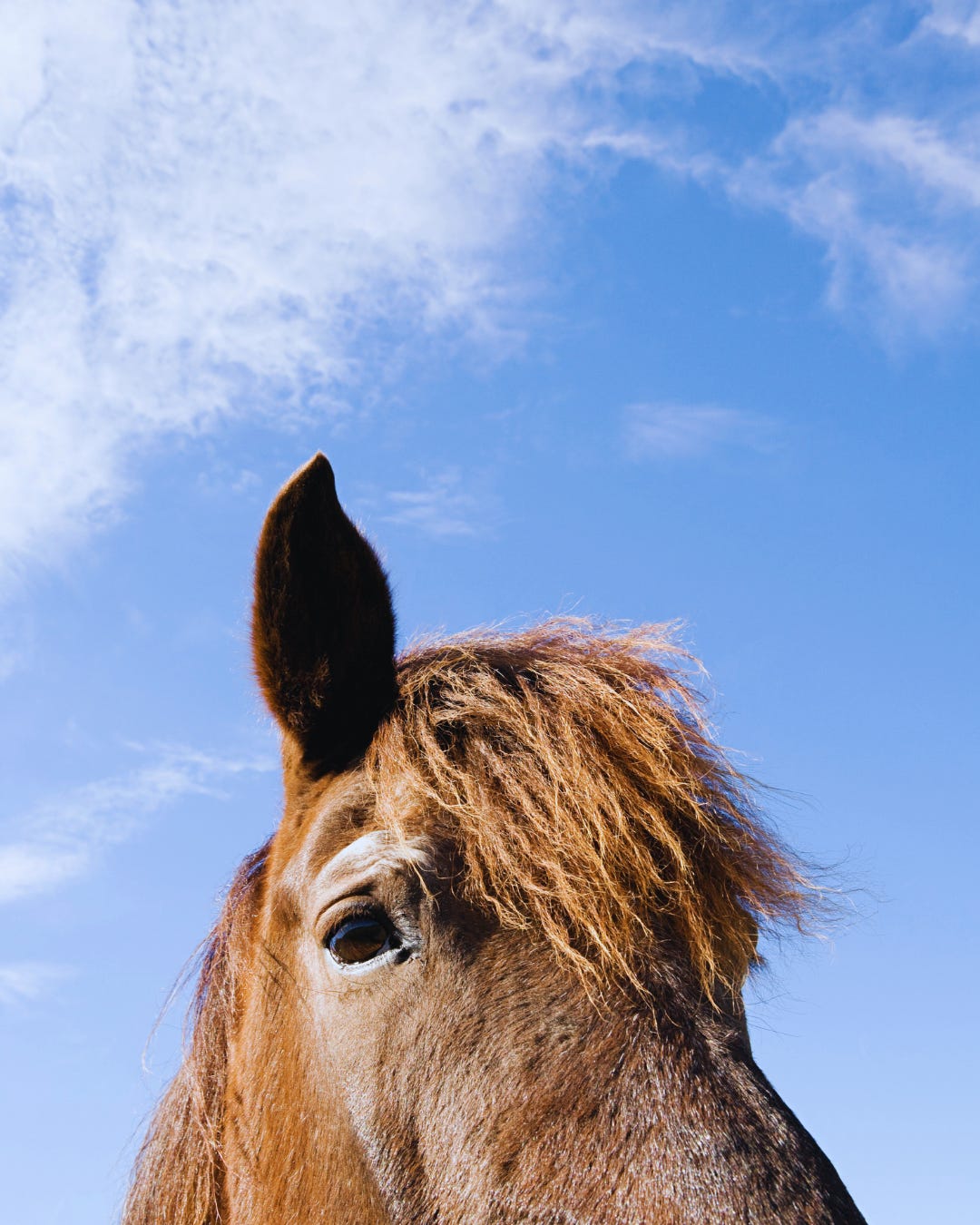
I’ve been seeing horses everywhere.
In every storefront along my street in Ho Chi Minh City, red and yellow decorations have begun to appear as the Lunar New Year approaches. Last week, family members gifted us two small wooden horse statues carved from dark wood. They now sit in my living room, watching me as I write this.
We are entering the Lunar Year of the Fire Horse. I’m not one to pay much attention to astrology, but I do love a good celebration. This upcoming year’s horse is a rare sixty-year cycle combination that signifies intense energy, rapid change and lots of so-called ‘innovation’. The year, in other words, is filled with what’s supposed to be some very tangible possibilities.
I find myself thinking about what the horse actually is. This sensitive animal that runs free across open grassland. But also the animal that was domesticated five thousand years ago and fundamentally altered the course of human history. The horse gave us progress and possibilities that literally built empires, connected trade routes and changed everything.
The wildness of the horse…and the human ambition and lust for progress. Were these two realities compatible? Could these truly exist together? Or did one have to be broken for the other to flourish?
This is the question I keep returning to. Not just what is possible, but what can exist together?
There is a word for this, though it sounds almost like a typo: compossibility.
Three centuries ago, a German polymath named Gottfried Wilhelm Leibniz was obsessed with a deceptively simple problem: if God is all-powerful, why doesn’t the world contain everything that could exist?
His answer was elegant. Not everything that is possible can exist together. Some possibilities cancel each other out. This universe is not the world of maximum possibility, but the world of maximum compossibility - the world in which the greatest number of compatible things can flourish together.
The philosopher Luis de Miranda puts it this way: “If everything is possible, not everything is compossible.” There’s something almost riddle-like about the sentence. And maybe that’s because it runs against a deep current most of us swim in: the belief that possibility is inherently good and that more options are always better than fewer. But de Miranda is suggesting something different. The task of our time is not to maximize possibility but to cultivate compossibility.
To maximize possibility is to ask: What can we do?
To cultivate compossibility is to ask: What can we do together, given this context and given what matters to us?
This second question requires us to dig into something beyond the ‘doing’. To figure out if something is compatible, we need to feel into our values. Two people who are sitting next to each other on a train may be destined to meet and fall in love. But that possibility relies on many things, including compatibility. And that compatibility is often a question of shared values. To sense into compossibility (compatibility + possibility), we need to sense into those values and the contexts from which they’ve grown.
‘Value’ is also a verb
Value is a noun, but it is first and foremost a verb, an action that’s almost on autopilot behind the scenes in our lives. It’s rare to actively think and ask yourself: what am I valuing in this moment? The last time I actively thought about values was in yet another leadership workshop where a long list of values was projected on the wall for us to pick from. We tend to speak of values as though they were things we can list on a pitch deck or embroider on a pillow. But values are actions. They are what we do when no one is watching, in the meetings we decline to spend dinner time with family and the smiles we offer strangers in the elevator. They are the choices we make, moment by moment about what matters to us.
I find myself less interested in the question what are your values? and more drawn to what are you actively valuing?
When I scroll past a news story because I’m tired, I am valuing comfort and maybe even ignorance. When I buy the plastic water bottle, I am valuing convenience. When we build technologies that maximize engagement without asking what they are maximizing engagement for, we are valuing blind growth. These aren’t necessarily wrong. But they are choices, even when they don’t feel like it.
And here’s the thing about this moment: possibility has exploded. You don’t need to hire a developer to build your next app, you can prompt one into existence. You could start three businesses on the side and still have time to make your bed in the morning. You can learn a language, publish a book, launch a podcast, all from a device that fits in your pocket. The gap between possibility and implementation has collapsed in ways that would be incomprehensible to anyone still alive who remembers horses being used for more than sport; people born eighty or ninety years ago, who witnessed the tail end of a world where possibility moved at the speed of muscle and steam.
We are living in a possibility era unlike anything we have ever known. And yet…something curious is happening.
People are valuing slowness and nostalgia. Actively, deliberately, with their time and their money.
Offline clubs are popping up in cities everywhere, with strangers paying for tickets to sit in a room together without their phones to do jigsaw puzzles, or draw, or just talk. People are building entire rooms in their houses devoted to the 1990s: boxy televisions, VHS players, record collections, analog everything. And it’s not only those of us old enough to remember them. Those born after 2000 who never even knew a world before smartphones are increasingly buying dumbphones. They are longing for a time they never even experienced.
Something is being valued here. Not efficiency. Not progress. Not ‘more’. Something closer to the opposite: the feeling of constraint as relief. The warmth of less.
In Four Thousand Weeks: Time Management for Mortals, Oliver Burkeman reminds that because human time is strictly limited (averaging about 4,000 weeks), so valuing one thing necessitates saying "no" to other things.
I think of what it felt like to choose a movie as a child. There were six VHS tapes on the shelf. Six possibilities. You picked one, you watched it, you lived inside it for two hours. The constraint was part of the experience. The limitation made the choice meaningful. Now with the infinite scroll, spending twenty minutes browsing and feeling vaguely dissatisfied with whatever we land on, I’m not sure the expansion of possibility has made any of us feel more free. If anything, it seems to leave us more restless, less able to settle into anything.
This is a compossibility problem. Infinite possibility sounds like freedom, but it turns out to be incompatible with the kind of presence, commitment, and depth that make choices meaningful.
Perhaps what many of us, the offline clubs, the dumbphone buyers and the twenty-somethings building shrines to decades they never lived through are all reaching for is not the past itself, but the compossibility of the past.
At Davos this January, Mark Carney declared: “Nostalgia is not a strategy.”
Tim Leberecht of the House of Beautiful Business offered a gentle correction, reminding us that nostalgia - from the Greek nostos (homecoming) and algos (pain) - is “the pain of an old wound, being cut off from something profoundly meaningful.” It is the human condition, Leberecht writes. And maybe it is also a value that points us toward the kind of compossibility we’ve lost.
Sensing into compossibility
And here is something else: compossibility is not static. It shifts. What could exist together in one era may become incompatible in another. What was once harmonious falls out of alignment as systems change, as contexts evolve, as new pressures emerge. The work of sensing into compossibility is never finished.
There is no shortage of systems thinking in the world. If we want to create positive change in the world, we need to understand how systems shift each other and how entangled they are. Because not everything that’s designed to create good in a system will actually create good. Possibility needs compatibility within a system. You can map much of that out, but that compatibility also needs to be sensed.
Sensing into compossibility is a practice, one that I consider part of systems feeling.
Systems feeling is the capacity to sense into a system to feel its rhythms, its tensions and its possibilities. It is what a skilled gardener does when she walks through her garden and knows, without being able to fully articulate why, that the garden needs. It is what an experienced community organizer does when she enters a room and feels where the energy is, who is ready to move and who is holding back.
Sensing into compossibility is a form of systems feeling. Not calculating all the possible outcomes and selecting the optimal one. But developing a collective sense of what fits, what belongs, what can flourish together. And recognizing that this sensing must be done again and again, because the system is always changing, and we are changing with it.
Compossibility is an invitation to ask not just what can we do? but what should we do together? An invitation to surface our values, including our nostalgia, our longing for home, our ache for a world where things fit, and to test our possibilities against them.
With kindness and curiosity,
Laura
Love this! Beautiful read, really got me thinking. And thank you for the new word! HNY 🐴🔥